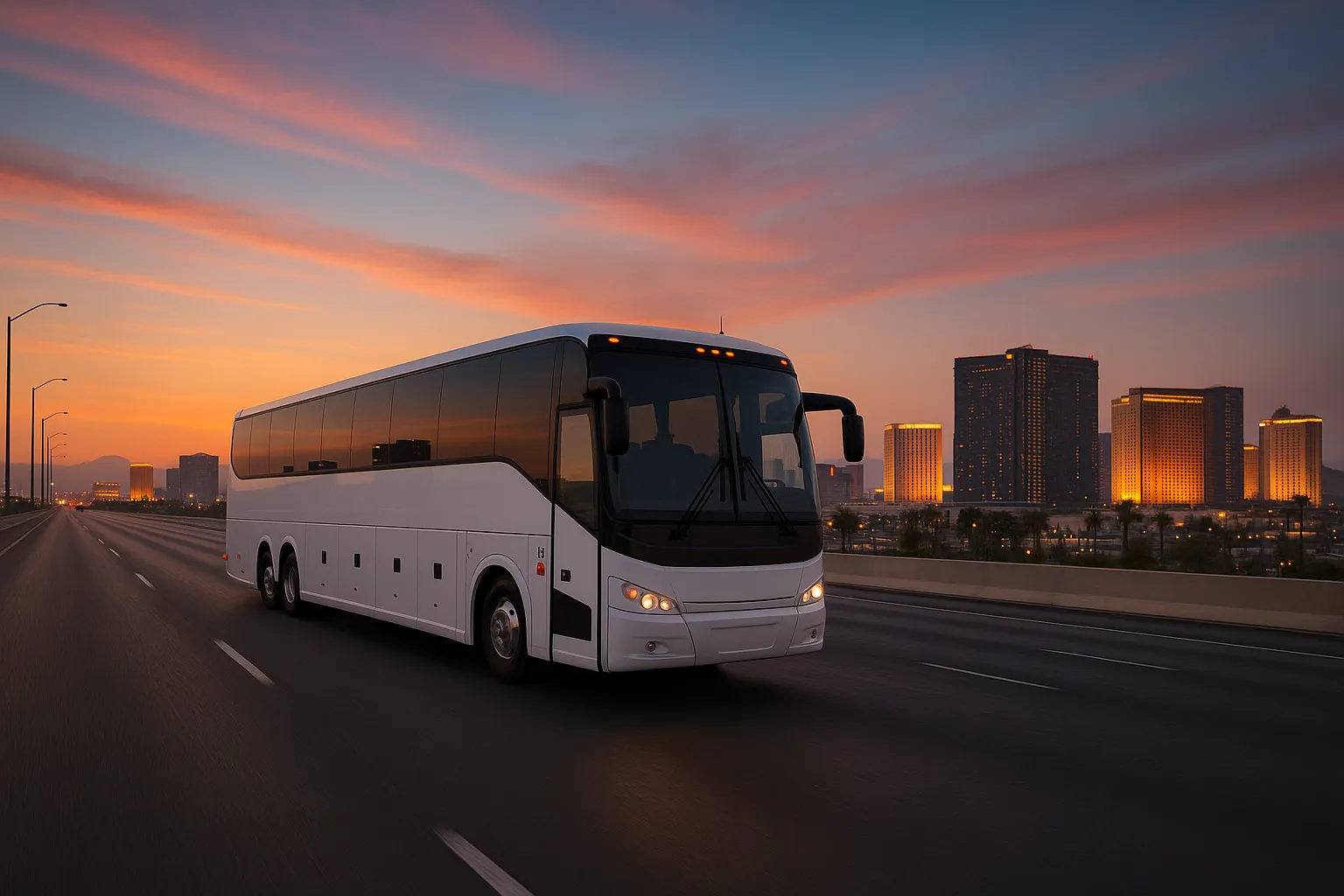
Las Vegas is a 24-hour labor market, and its workforce moves in shifts, not rush hours. UCN builds recurring employee shuttle programs with vetted local operators, resort back-of-house runs, employee-lot loops, Henderson and Summerlin commuter routes, priced per route per service day so operations and finance see the same clear number.
Get an instant quote →Resort-corridor employers face a transportation problem few other cities have: tens of thousands of employees converging on the Strip where parking is scarce, expensive, or deliberately reserved for guests, across shift changes at 3 a.m., 11 a.m., and 7 p.m. The standing fix is the employee shuttle, loops between remote employee lots and back-of-house entrances, or commuter routes from the neighborhoods where staff actually live: Henderson, North Las Vegas, Summerlin, Spring Valley. We match each route to an operator who commits the same vehicles and drivers daily, because shift workers plan their lives around a shuttle that must not be approximate.
Beyond the resorts, the pattern repeats wherever shift work concentrates: warehouse and logistics parks in North Las Vegas running 6 a.m. and 6 p.m. changeovers, stadium and arena event-staff surges on game nights, and construction workforce moves for the valley's endless build-out. Minibuses of 24 to 38 seats fit most loops; 56-seat coaches carry the heavy commuter corridors. Recurring programs price per service day, well below one-off charter rates, against a full-day coach benchmark of $950 to $2,100.
| Vehicle | Hourly | Daily | Min hours |
|---|---|---|---|
| Sedan | $75–$95 | $700–$900 | 4 hrs |
| SUV | $90–$120 | $750–$950 | 4 hrs |
| Van | $105–$135 | $950–$1,250 | 5 hrs |
| Minibus | $140–$180 | $1,450–$1,850 | 5 hrs |
| Motorcoach | $175–$225 | $1,800–$2,300 | 5 hrs |
Live marketplace rates — exact quotes depend on date, mileage and availability.
Rates updated July 2026
A minibus circulates between a remote employee parking lot and a resort's back-of-house entrance on a 12-minute headway, bracketing each shift change with extra runs. Employees stop burning 25 minutes and a parking fee each way, and HR stops hearing about it in exit interviews.
A coach collects staff at two park-and-ride points in Henderson or Summerlin and delivers them to the resort corridor before the morning shift, with a reverse run after close. One vehicle replaces sixty single-occupant car trips down the 215 and a row of parking stalls the property can monetize instead.
Game nights at Allegiant and arena events need hundreds of extra workers landed and lifted in tight windows. Shuttles run compressed loops from staff lots before doors and after close, scheduled off the event calendar month by month. Operators used to event-day traffic control keep the loops moving when the grid locks.
Priced per route per service day: minibus loops typically run in the mid hundreds daily and a full-size coach day lands around the $950 to $2,100 benchmark before recurring-program discounts. An annual five-day route is negotiated as a program, and per-day cost usually undercuts the parking it replaces.
Yes, and in this market they must. Operators here staff around 24-hour operations as a matter of course, so 3 a.m. shift changes, split swing coverage, and weekend-heavy schedules are all normal to quote. The route runs on your shift calendar, not a commuter clock, and pricing follows service hours.
Around 15 to 20 consistent riders per corridor for a 24 to 38 seat minibus; below that we will honestly point you to vanpool-style alternatives. The predictor that matters is address clustering from HR data, one tight Henderson cluster supports a route that 50 scattered interested employees cannot.
Yes, that is a condition we set with the operator: a committed primary driver and vehicle plus a named backup per route. On back-of-house runs the driver also learns your security gates, badge checks, and supervisors, which quietly removes a daily source of friction no spreadsheet ever captures.
Two to three weeks from HR zip-code data to a live route: several days for route and stop design, the rest for operator contracting and employee communication. Most employers pilot for 60 to 90 days with per-run ridership counts, then resize the vehicle or adjust stops before committing to a full year.
One clear price from a vetted local operator — in seconds, no obligation.