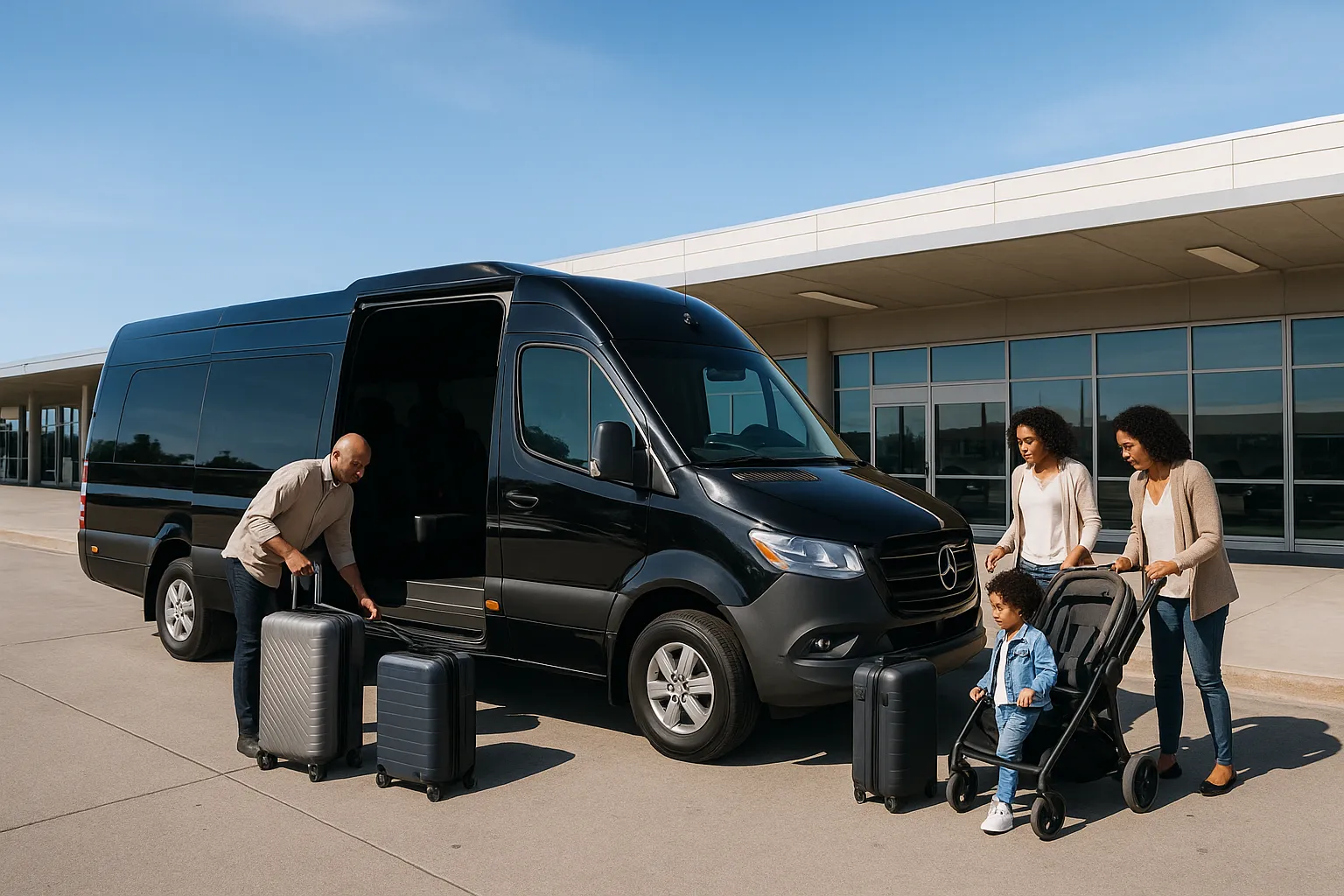
Long Beach is a small, fast airport with an unusually big group mission: cruise passengers heading to the downtown port, convention attendees, Cal State Long Beach visitors and race-weekend parties. A sprinter van, minibus or motorcoach collects everyone at once instead of splitting a party across cars. Price it instantly, all in, with a vetted operator based in the harbor area.
What makes Long Beach distinctive for group work is how close the demand sits to the airport. The Long Beach Convention and Entertainment Center, the downtown hotel cluster, the cruise terminal on the harbor side, the Queen Mary, the Aquarium of the Pacific and Cal State Long Beach are all short runs. Groups arriving here are frequently sailing, attending a meeting downtown, visiting the university, or continuing to Anaheim or the South Bay. The short distances mean planners often keep a vehicle on hourly standby rather than booking a series of one-way legs.
A pickup at Long Beach feels different from a pickup at a major hub. The historic 1941 terminal building anchors the landside, boarding happens at ground level from open-air concourses, and the walk from aircraft to the street is short enough that a group typically arrives at the meeting point together. That tight assembly window suits coach work, because the driver is not absorbing a long, unpredictable trickle. Large vehicles still load from designated commercial positions rather than the private car lane, and the airport has been improving its terminal areas, so confirm the current coach loading arrangement with airport ground transportation.
Passenger traffic here is domestic and runs through a single compact terminal complex organized around the historic terminal building and its open-air concourses, so there are no customs queues to model and no long inter-terminal walks. Baggage claim is small and sits close to the doors. The practical consequence is that Long Beach timing should be planned tighter than a large airport: a group can be outside within minutes of the aircraft parking, and a vehicle that is positioned too late becomes the bottleneck. Long Beach also has long-standing noise and flight-slot restrictions, which is why late-night schedules need to be verified.
On the marketplace, you get an all-in price for the exact itinerary you enter, immediately, with no quote callback. The work is matched to a vetted charter-party carrier in the Long Beach and greater Los Angeles market, generally one yarded close enough to handle a delay without a wasted repositioning. Flight tracking ties the pickup to the real arrival time, not the published one. Agreements are signed electronically, itinerary changes are recorded against the booking so nothing drifts between customer and operator, and live tracking on service day shows the group leader exactly where the vehicle is.
Terminals:
Because the walk from aircraft to street is short, groups reach the meeting point quickly. Plan the vehicle to be in position around the arrival time rather than comfortably after it.
Motorcoaches and vans load from commercial ground transportation positions rather than the private car lane. Confirm the current position with the operator, or with airport ground transportation if your group has special needs.
Terminal parking is built for cars, not for a coach or high-roof van. Any extended driver wait happens off the terminal frontage; do not plan on a driver parking and walking in.
Long Beach has long-standing noise restrictions and limits on flight activity. If your ground plan depends on a late arrival or departure, verify the flight first.
| Vehicle | Hourly | Daily | Min hours |
|---|---|---|---|
| Motorcoach (47–56 pax) | $175–$260 | $1,700–$2,500 | 5 hrs |
| Minibus (24–35 pax) | $140–$205 | $1,350–$1,900 | 5 hrs |
| Sprinter van (10–14 pax) | $120–$180 | $1,000–$1,500 | 4 hrs |
Typical published ranges. Excludes driver gratuity (10–20%), tolls, parking and airport or venue fees; fuel is included on local trips and peak dates can run 10–20% higher. Your instant quote is one all-in price for your exact trip.
Rates updated September 2026
Passengers flying in for a sailing take a short coach run from the airport to the cruise terminal, then book the reverse leg for debarkation morning when the whole ship empties at once.
Delegations working the Long Beach Convention Center arrive in waves and move between the downtown hotel block and evening venues on a repeating shuttle.
Move-in, family weekend and commencement bring families and visiting groups through LGB. Minibuses navigate campus loops better than full-length coaches.
The downtown street circuit weekend fills the harbor area, and hospitality groups move guests between hotels, the paddock area and dinners on a dedicated vehicle.
Engineering and program teams flying into Long Beach for site visits in the South Bay commonly hold an executive sprinter van for the day rather than renting separate cars.
Some planners deliberately fly into Long Beach for the fast exit and coach onward, trading a longer drive for far less time spent inside a terminal.
🚏 Frequent destinations: Long Beach Convention and Entertainment Center, Downtown Long Beach hotel district, Long Beach cruise terminal and the Queen Mary, Aquarium of the Pacific and Shoreline Village, California State University, Long Beach, Catalina Express landing, Anaheim resort district, Downtown Los Angeles and the convention hotel block, SoFi Stadium and Inglewood and Huntington Beach and the Orange County coast.
📅 Busiest periods: The downtown Long Beach street race weekend in spring, Cruise season peaks in summer and around the winter holidays, Convention and trade show calendar at the Long Beach Convention Center, Cal State Long Beach move-in and commencement, Summer waterfront festivals along Shoreline Drive and Holiday-period group travel in late December — book those weeks early.
Buses head out from Los Angeles across a coast-to-coast network of vetted local operators — active in 11+ markets.

It is one of the shortest airport-to-pier runs in the region, which is why it is popular for sailings out of the local port. The bigger planning issue is debarkation morning, when an entire ship releases passengers in a narrow window. Book the return leg with a realistic pier pickup time and keep the group on one vehicle.
Faster than most people expect. Boarding and deplaning happen at ground level, the concourses are open-air, and the claim area is close to the doors. Plan the vehicle to be in position around the arrival rather than well after it, and rely on flight tracking to shift the target.
At designated commercial ground transportation positions rather than the private car lane, a short walk from the terminal. The airport has upgraded its landside areas over time, so re-confirm the meeting point close to the date with the operator or airport ground transportation.
Sprinter vans carry up to about 14, minibuses roughly 25 to 35, and motorcoaches 49 to 56. For campus loops, hotel driveways and downtown Long Beach streets, a minibus is often easier to work with than a full coach even when the headcount fits the larger vehicle.
Yes, and for Long Beach itineraries it is often the better structure. Distances between the airport, the convention center, the waterfront and the hotels are short, so a vehicle on standby usually beats a sequence of one-way legs for both convenience and schedule control.
Lift-equipped vehicles can be requested with the booking. Accessible equipment is a limited part of any market's fleet, so request it as early as possible and tell the operator the number of wheelchairs, whether they are manual or powered, and whether riders will transfer to a seat.
One clear price from a vetted local operator — pickup time follows your flight.