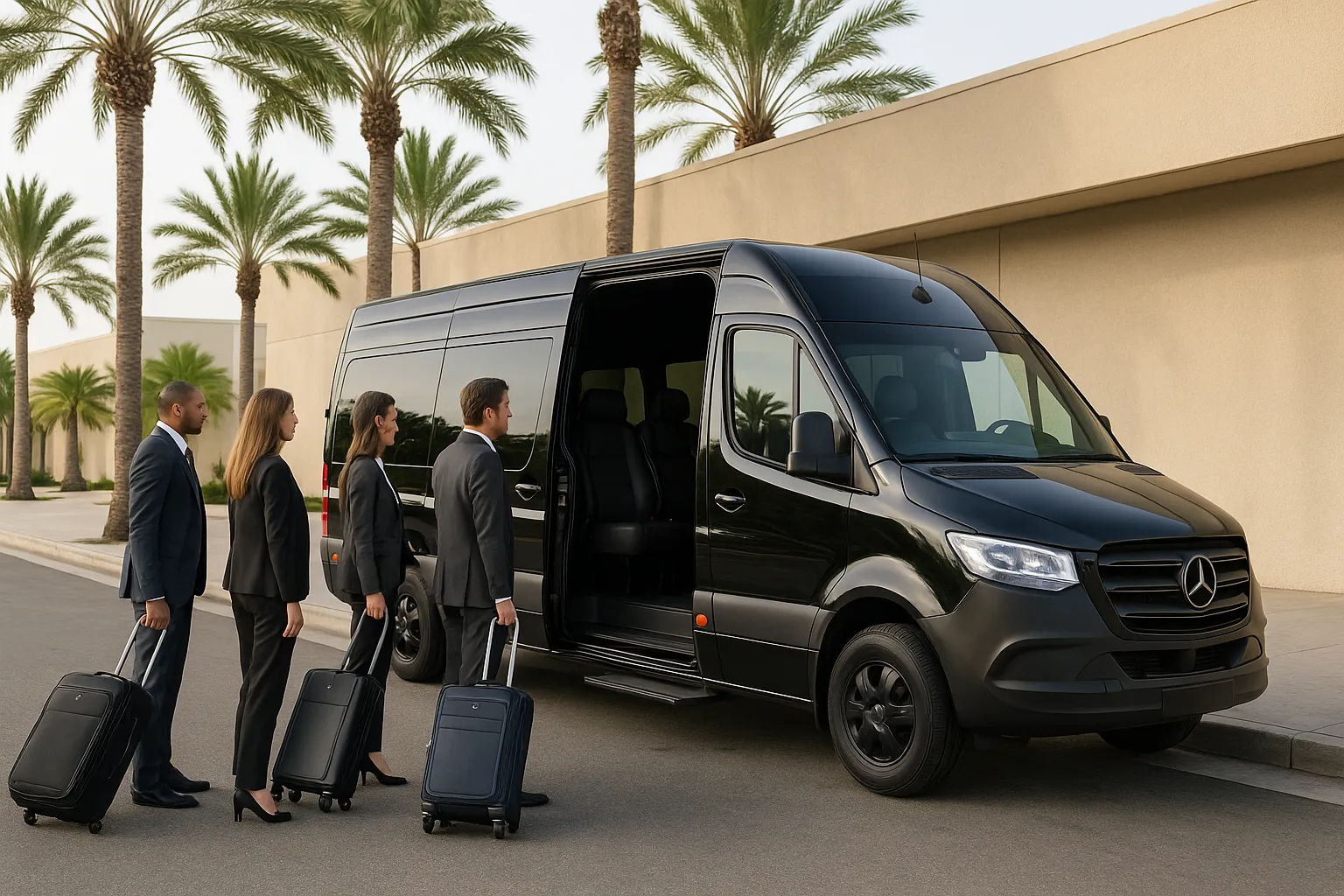
Burbank is the airport Los Angeles groups choose when they want to be out of the building in ten minutes. Production companies, studio guests, corporate teams visiting Media District offices and youth sports squads fly in here and board a coach a short walk from the gate. Price a sprinter van, minibus or motorcoach instantly and get a vetted San Fernando Valley operator.
The group traffic through Burbank leans heavily toward business and entertainment. Studio and network visitors, post-production teams, agency and brand groups working in the Media District, plus family and youth sports parties headed for Valley tournaments, all arrive here rather than fighting the westside. Because the airport sits inside the San Fernando Valley, the natural runs are short: Burbank and Toluca Lake hotels, Universal City, Glendale, Pasadena, Hollywood over the hill, and Santa Clarita to the north. Planners like it precisely because the transfer is measured in minutes, not in freeway roulette.
Ground handling at Burbank is refreshingly simple by Los Angeles standards. The airfield is famous for boarding at ground level, and the walk from gate to curb is short enough that a group tends to arrive at the pickup point together instead of trickling out over half an hour. That compression is an advantage for coach work: the driver gets a realistic window rather than an open-ended wait. Large vehicles still use designated commercial positions rather than the general passenger lane, and a replacement terminal project has been reshaping the landside, so confirm the current coach loading arrangement with airport ground transportation.
Historically the passenger buildings have been identified as Terminal A and Terminal B, sharing one compact ticketing and baggage area, with a new consolidated terminal under development on the north side of the field. Everything is domestic, so there is no customs queue to model and no meaningful gap between wheels-down and a group standing outside. Baggage claim is small and sits close to the doors, which is why a Burbank pickup often runs ahead of the schedule a planner would set for a larger airport. Keep in mind the field's long-standing nighttime noise restrictions when planning late departures.
On the marketplace you get an all-in price on the spot, with the itinerary you actually entered rather than an estimate to be revised later. The work is assigned to a vetted charter-party carrier operating in the Los Angeles market, usually one yarded in the Valley, which keeps repositioning short if a flight slips. Arrival tracking adjusts the pickup to the real landing time. Agreements are signed electronically, changes are recorded against the booking rather than buried in an email chain, and live tracking on the day lets a group leader see exactly where the vehicle is.
Terminals:
The landside is compact, which is good for assembling a group quickly and less forgiving of a large vehicle sitting still. Operators generally time the approach to the group rather than parking early.
A replacement terminal program has been altering roadways and lots here. Do not assume last year's meeting point still applies; confirm with the airport or have the operator re-confirm the week of travel.
Burbank has long-standing nighttime noise restrictions that shape the late flight schedule. If your itinerary depends on a late departure, verify the flight exists before building the ground plan around it.
Covered parking structures serving the terminal are sized for cars. A motorcoach or high-roof van waits at surface level or off-airport; plan any extended driver wait accordingly.
| Vehicle | Hourly | Daily | Min hours |
|---|---|---|---|
| Motorcoach (47–56 pax) | $175–$260 | $1,700–$2,500 | 5 hrs |
| Minibus (24–35 pax) | $140–$205 | $1,350–$1,900 | 5 hrs |
| Sprinter van (10–14 pax) | $120–$180 | $1,000–$1,500 | 4 hrs |
Typical published ranges. Excludes driver gratuity (10–20%), tolls, parking and airport or venue fees; fuel is included on local trips and peak dates can run 10–20% higher. Your instant quote is one all-in price for your exact trip.
Rates updated September 2026
Talent, panels and audience groups arriving for tapings move from Burbank to Media District lots in a matter of minutes. Executive sprinter vans are the common choice for small parties.
Crews landing with cases and equipment need luggage bays, not trunks. A minibus or coach handles the people while the bays absorb what would otherwise take three extra vehicles.
Teams flying in for a one-day session often keep a vehicle on standby between the office, lunch and the return flight rather than booking separate legs.
Valley and Santa Clarita tournaments draw teams into Burbank because the transfer is short. One coach carries players, coaches and equipment to the hotel and then to every game.
Universal City is one of the shortest airport-to-attraction runs in the region. Groups frequently book the arrival transfer and the park day shuttle together.
Some planners deliberately fly into Burbank and coach over the hill to Hollywood or downtown, trading a longer drive for a much faster exit from the terminal.
🚏 Frequent destinations: Burbank Media District studios and offices, Universal City and Studio City, Toluca Lake and North Hollywood hotels, Glendale and the Americana district, Pasadena and the Rose Bowl, Hollywood and West Hollywood, Santa Clarita and Valencia, Downtown Los Angeles and the convention hotel block, Woodland Hills and Warner Center and Thousand Oaks and the Conejo Valley corporate corridor.
📅 Busiest periods: Television production and pilot season activity in the Media District, Awards season events across Hollywood and Pasadena in January and February, Spring and summer youth sports tournaments in the San Fernando Valley, Summer theme park peak at Universal City, Rose Bowl and New Year's events in Pasadena and Corporate fiscal year kickoffs in Glendale and Burbank — book those weeks early.
Buses head out from Los Angeles across a coast-to-coast network of vetted local operators — active in 11+ markets.

Exit speed. The terminal is small, the walk from gate to curb is short, and a group tends to assemble in one piece instead of dribbling out over half an hour. For anything happening in the Valley, Glendale or Pasadena, the total door-to-door time is usually better even though the flight options are fewer.
At a designated commercial vehicle position rather than the general passenger lane. Because the landside has been under construction, the exact spot is worth re-confirming close to the date. Your operator will send a meeting point, and airport ground transportation can confirm current commercial arrangements.
Often yes. A motorcoach has substantial under-floor bays and a minibus usually has some luggage capacity, but hard cases and equipment eat that space faster than suitcases do. Tell the operator what you are carrying in advance so the vehicle is sized for the cargo, not only the headcount.
There is no customs step here, so the gap between landing and a group standing outside is short. Most planners have the vehicle in position around the arrival time rather than well after it. Flight tracking on the booking moves that target if the aircraft is early or late.
Sprinter vans seat up to about 14, minibuses roughly 25 to 35, and motorcoaches 49 to 56. Wheelchair lifts can be requested when you book. For a group carrying full checked luggage, size up rather than filling every seat.
Yes, and for short Valley itineraries that is often the practical choice. Holding one vehicle and one driver across the day avoids repeated repositioning into a small terminal area and keeps the group on a single schedule.
One clear price from a vetted local operator — pickup time follows your flight.