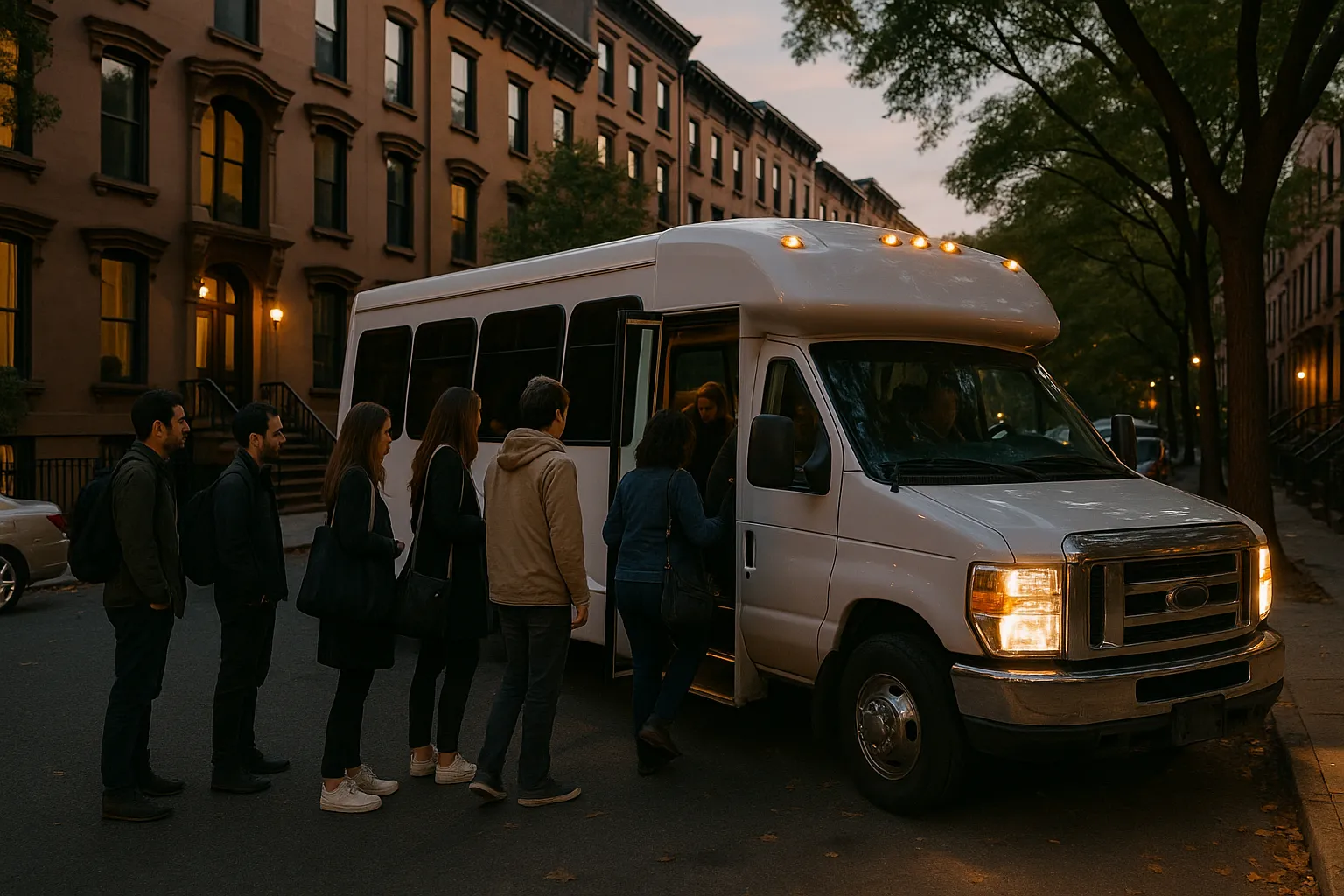
In New York the question is never how many seats but where the vehicle can legally stand. A 25 to 35 seat minibus works Manhattan curbs, parkway-restricted suburbs and outer-borough streets with one professional driver, a vetted local operator and an instant all-in price.
New York minibus work is mostly movement between constrained places. Corporate groups shuttle between Midtown hotels and an office downtown or in Long Island City. Conference organizers run loops to the Javits Center. Wedding parties move guests from a Manhattan hotel to a venue in Brooklyn, Westchester or the Hudson Valley. Schools and universities book them for museum and campus days, film and media crews use them around the boroughs, and families book them for Hamptons and Catskills weekends.
The class seats 25 to 35 in forward-facing rows, runs roughly 30 to 35 feet, and stores bags in a rear compartment and overhead bins instead of a full under-floor bay. Climate control handles both January and August here. Wi-Fi and power outlets appear on some units, useful on a Hudson Valley leg. Lift-equipped units can be arranged on request. Most units have no restroom, and one professional driver stays with the charter, which in this city also means one person managing the curb.
Length and height both matter more here than anywhere else in the country. The region's parkways, including the Belt, Hutchinson River and Saw Mill, are closed to commercial vehicles and carry low stone overpasses, so charters route on interstates and truck-legal roads regardless of size. Within that, a minibus can use loading zones and hotel curbs a 45-foot coach cannot, and it turns on Brooklyn and Lower Manhattan blocks that defeat a motorcoach. What it cannot do is park for free anywhere near your venue, so plan for the driver to stage off site.
The whole booking runs on the marketplace. Enter your stops, see one all-in price that already accounts for driver hours, fuel and the tunnel and bridge tolls your route uses, then e-sign. A vetted local operator with the right authority for New York work takes the job, with live tracking and a named contact for the day. Give the operator exact street addresses and cross streets rather than venue names, because in this city the difference between two corners decides whether the vehicle can legally stop.
25–35
rear compartment sized for carry-ons and a handful of large bags, plus overhead bins
Midtown to downtown and Long Island City corporate shuttles · Javits Center and hotel conference loops · wedding shuttles to Brooklyn, Westchester and the Hudson Valley · LaGuardia, JFK and Newark group transfers · school, museum and campus visit days · Hamptons, Catskills and Hudson Valley weekend runs
itineraries that assume parkway routing, which is closed to charter vehicles · groups above 35 that need one vehicle · long day trips with no restroom stop planned
| Minibus (24–35 pax) | Hourly | Full day | Minimum | Per mile (long trips) |
|---|---|---|---|---|
| Typical rate | $165–$250 | $1,650–$2,250 | 5 hrs | $7.00 |
Typical published ranges. Excludes driver gratuity (10–20%), tolls, parking and airport or venue fees; fuel is included on local trips and peak dates can run 10–20% higher. Your instant quote is one all-in price for your exact trip.
Rates updated September 2026
Move a team between a Midtown hotel and an office in the Financial District or Long Island City. The driver will work a legal loading zone and stage off site between legs rather than hold a lane.
Run attendees between West Side hotels and the Javits Center on a repeating schedule. Far West Side traffic is the constraint, and a shorter vehicle merges and turns where a coach queues.
Carry guests from a Manhattan hotel block out to a venue in Red Hook, Westchester or up the Hudson, then run late returns. Route planning avoids the parkways entirely, so allow for the longer interstate path.
Collect an arriving group at LaGuardia, JFK or Newark and deliver them to one hotel. Each airport has its own charter staging rules, so give the operator terminal and flight details well before the day.
Run a class between the Museum of Natural History, the Met and a downtown stop. School drop zones and museum bus curbs are sized for this class and get crowded, so arrival timing matters.
Take a group east on the Long Island Expressway or north on the Thruway for a weekend. Plan a comfort stop each way, since most minibuses have no restroom and the traffic can double the drive.
A coach earns its place on a long Hudson Valley or Boston run with a restroom and real bags. In the five boroughs it is a liability: fewer legal curbs, harder turns and more streets it simply cannot enter. The minibus goes more places here.
A Sprinter seats up to 14 and is the right tool for an executive party or a small JFK pickup. Above the mid-teens, one minibus means one driver managing one curb instead of two vehicles fighting for the same twenty feet.
Three vans in Manhattan means three curb negotiations and three arrival times that will not match. One minibus stops once, loads once, and is far easier for a hotel doorman to accommodate.
Buses head out from New York across a coast-to-coast network of vetted local operators — active in 11+ markets.
No. The region's parkways, including the Belt, Hutchinson River and Saw Mill, are restricted to passenger vehicles and carry low stone overpasses that were never built for buses. Charter routing uses interstates and truck-legal roads, which sometimes adds time versus a route your phone suggests.
Off site, almost always. There is very little legal long-term standing for buses in Manhattan, so the driver will stage in a permitted area and return for your pickup time. Give the operator realistic call times so the vehicle is back at the curb when you need it rather than circling.
Yes. Tunnel, bridge and highway tolls on the route as you built it are inside the all-in price, including the Hudson River crossings when your itinerary uses them. Added stops on the day are documented by the operator rather than billed as a later surprise.
The large majority of this class does not carry one. For city work that is a non-issue. For a Hamptons, Catskills or Philadelphia run, agree on a rest stop with the driver before departure, or consider a full-size coach for the comfort.
Snow and ice slow everything and occasionally close a crossing or a bridge. Operators track conditions and your named contact will reach you if the plan needs to change. For winter airport transfers, build in extra time rather than booking to the minute.
Large Javits shows, graduation season, the fall and spring school trip peaks and the holiday weeks are the tightest periods, and the region's minibuses book out for them. Reserve those well ahead. Weekday corporate shuttles are usually easier on shorter notice.
One clear price from a vetted local operator — in seconds, no obligation.