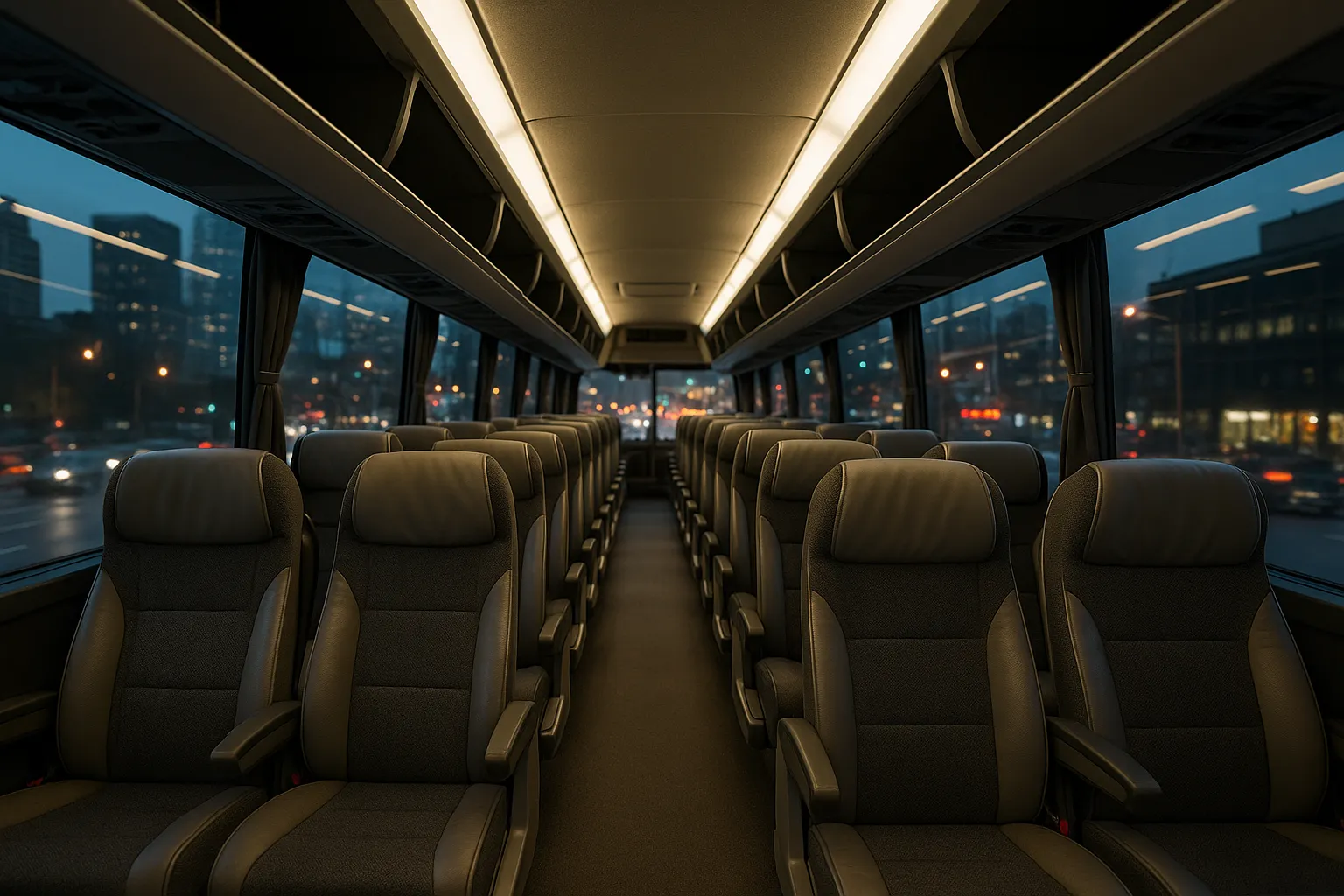
In New York a 56-passenger charter bus is how a group avoids the subway with luggage and the parkway system entirely. Schools, associations, wedding parties, and corporate groups use one coach for JFK and Newark arrivals, Javits Center shuttles, MetLife Stadium nights, and day trips up the Hudson.
New York's coach bookings skew toward groups that cannot afford to arrive in pieces. School and youth groups come in for museum and Broadway days. Associations and exhibitors run hotel shuttles to the Javits Center. Wedding parties move guests between Manhattan or Brooklyn hotels and venues in New Jersey, Westchester, and Long Island. Corporate groups travel to conferences and to MetLife Stadium and Yankee Stadium events. Tour operators build Woodbury Common, Hudson Valley, West Point, and Washington and Boston itineraries out of the same vehicle.
The vehicle is a full-size motorcoach: 49 to 56 reclining seats, an onboard restroom, climate control, a PA that a guide or group leader can actually use, power outlets, and Wi-Fi on most coaches. Under-floor bays carry roughly one large bag per passenger, which is the difference between a manageable arrival and fifty people hauling suitcases through a terminal. One professional driver works the day within federal hours-of-service limits, and ADA lift-equipped coaches are available on request when you book in advance.
Size and street law are the whole game here. A coach is about 45 feet long and 12 to 13 feet tall, which means it is barred from the region's parkways, where low stone overpasses were built for cars only, and it cannot enter any Manhattan garage. Curbside dwell is limited and idling rules are enforced, so a coach drops, leaves, and returns on call rather than waiting. Village and Brooklyn brownstone streets are too narrow, and tunnel, bridge, and Manhattan congestion tolls are part of every routing.
Umbrella Charter Network prices the trip the moment you enter pickup, stops, and times, so you are not waiting on a callback to plan a schedule. The job is assigned to a vetted local operator who knows which crossings work for a 45-foot vehicle, where a coach may legally load near a Midtown hotel, and how long the Lincoln Tunnel approach takes at four in the afternoon. The agreement is signed online, and live tracking means your group leader sees the coach coming.
49-56
under-floor bays for roughly one large bag per passenger
JFK, LaGuardia, and Newark group arrivals with checked luggage · Javits Center and Midtown hotel conference shuttles · School and youth group museum and theater days · Wedding guest shuttles to New Jersey, Westchester, and Long Island venues · MetLife Stadium, Yankee Stadium, and Barclays Center event groups · Hudson Valley, West Point, and Woodbury Common day trips
Parkways with low clearances that prohibit commercial vehicles · Any Manhattan parking garage or hotel ramp · Narrow streets in the West Village, Chinatown, and Brooklyn brownstone blocks · Small groups of a dozen or fewer moving around Manhattan
| Motorcoach (47–56 pax) | Hourly | Full day | Minimum | Per mile (long trips) |
|---|---|---|---|---|
| Typical rate | $195–$325 | $1,900–$3,000 | 5 hrs | $8.00 |
Typical published ranges. Excludes driver gratuity (10–20%), tolls, parking and airport or venue fees; fuel is included on local trips and peak dates can run 10–20% higher. Your instant quote is one all-in price for your exact trip.
Rates updated September 2026
Both airports have designated charter staging away from the terminal curb, and one coach clears an arriving group's checked bags in a single load. Send flight numbers so the driver stages to the actual landing rather than the scheduled one.
A coach loops between Midtown hotels and the convention center on a published headway during a show. Loading near Javits and along Midtown avenues is tightly regulated, so the meeting point is set by where a coach may legally stop.
One coach brings a class in, drops at the museum, stages off-site, and returns for the evening departure. Manhattan does not allow a large vehicle to sit at the curb, so the pickup point and window are part of the plan from the start.
Guests load at a Manhattan or Brooklyn hotel and go to a venue in New Jersey or Westchester together, which removes both parking and the late-night drive home. Tunnel and bridge timing drives the schedule more than the distance does.
The stadium has motorcoach lots and defined drop zones, and a group that arrives together leaves together instead of scattering into the Meadowlands exit queue. Set a pickup window rather than a pickup time.
A coach runs the Thruway comfortably and the onboard restroom means no service-plaza stop on the way up. Parkway restrictions mean the route north is not the one a car would take, and the operator plans for that.
A 25 to 35-seat minibus can work narrower streets and some tighter venue approaches that a coach cannot, which helps in Brooklyn and the Village. It still cannot use restricted parkways in most cases, and it has no restroom for a Hudson Valley run.
A sprinter van seats up to 14 in executive configuration and is the practical choice for an executive team between Midtown and an airport. For a school group or a wedding guest list it multiplies into a convoy immediately.
Two vehicles in New York means two sets of curb permissions, two toll crossings, and two arrival times into traffic that does not cooperate. One coach is simpler for the driver, the venue, and the person holding the timeline.
Buses head out from New York across a coast-to-coast network of vetted local operators — active in 11+ markets.
The region's parkways were built with low stone overpasses and are restricted to passenger vehicles, so commercial buses are prohibited. That is why a coach route to Long Island or Westchester follows expressways and other truck-legal roads, and why the map time a car app shows is not the coach's time.
It generally cannot wait at the curb. New York limits standing and enforces idling rules, so the operator drops your group, stages the coach at an approved layover location, and returns on call. Give the driver a pickup window and a spot the group can reach on foot.
Tunnel and bridge crossings and the Manhattan congestion relief zone are part of any routing that enters the city, and the operator accounts for them in the trip. What you should plan around is time, because the approaches to the Lincoln and Holland tunnels back up badly at peak.
Sometimes, and sometimes not. Many brownstone blocks and older downtown streets have no room for a 45-foot vehicle to turn or load. Operators commonly set a staging point on a nearby avenue that can receive a coach, which usually works fine if you plan it in advance.
Yes, and groups do both regularly. Each is long enough that federal hours-of-service limits become the binding constraint once you add time at the destination, so the operator will check the schedule and may recommend an overnight or a second driver.
Spring school trip season, major Javits shows, holiday weeks, and the fall wedding calendar all compress supply across the region. Six to ten weeks is comfortable for most dates, and a spring weekday during school trip season deserves considerably more.
One clear price from a vetted local operator — in seconds, no obligation.