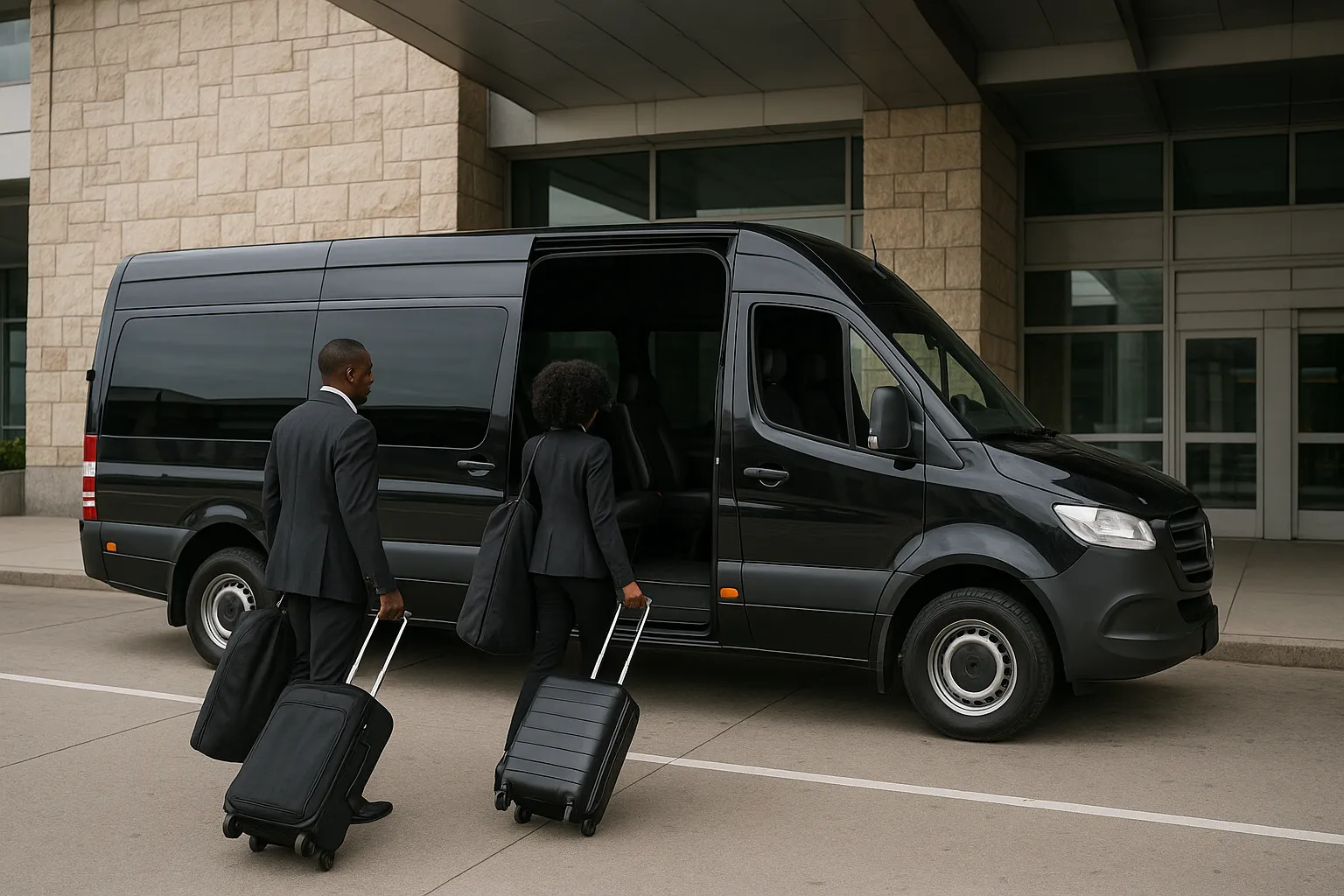
Reagan National is the closest airport to the capital, which makes it the default for fly-in groups: association boards, advocacy delegations, student tours and corporate teams. Charter minibuses and motorcoaches move them from the terminals to Capitol Hill, downtown hotels and National Harbor on an instant all-in price.
Reagan National draws the group travel that has business in the city itself. Association fly-ins, advocacy delegations, agency and contractor teams, school groups on a Washington itinerary and wedding parties heading for Old Town or National Harbor all arrive here rather than the region's long-haul gateway, because the airport sits directly across the river from downtown. Traffic is largely domestic and short-haul, so parties tend to land inside a narrow band of flights with modest luggage. The short distance to the city is the whole appeal, and a charter turns that proximity into a single clean movement.
The pickup here is shaped by a compact, busy site with a constrained roadway. Charter buses are directed to designated commercial vehicle positions rather than the main arrivals curb, and drivers hold in a staging area until the group is downstairs with bags, because curb dwell is tightly managed. For a larger party, a greeter meeting the group at baggage claim and walking them out as one block is far more reliable than trying to find each other at the curb. Lane assignments here have shifted with construction over the years; confirm with airport ground transportation before the day.
The airport is organized as Terminal 1 and Terminal 2, the latter carrying most of the airline volume across its concourses and connected by the main hall. International service is limited compared with the region's larger gateway, so customs rarely drives a group's timeline. The terminals sit far enough apart on the roadway that a group split across airlines should verify which building each flight uses before choosing a single meeting point. Metro serves the airport directly, which some planners use for individuals traveling separately from the chartered main body.
For a fly-in, the schedule is usually fixed months ahead and the transport has to be locked with it. On Umbrella Charter Network the all-in price appears immediately, so a board can approve the line item without waiting on quotes, and a vetted local operator that regularly works the Washington curbs is assigned to the run. Flight tracking ties the pickup to the real arrival, the agreement is signed electronically, and live tracking covers the day. Lift-equipped vehicles are requested at booking so accessibility is planned rather than improvised.
Terminals:
Charter coaches at Reagan National load at assigned bus and commercial vehicle positions, not the general arrivals curb. The exact position depends on the terminal and has moved with airport projects, so confirm the current one with airport ground transportation rather than reusing last year's instructions.
With a compact roadway and heavy taxi and rideshare volume, the practical method is for the driver to hold in a staging or cell phone area and come in once the group leader confirms everyone is at the door. Circling the terminal loop wastes more time here than waiting does.
Getting to the city is easy; parking a coach once there is not. Washington restricts where large vehicles may stand near the Mall and the government core, and security perimeters can close streets with little notice. The operator plans layover and stop points in advance, and venue or city guidance should be confirmed for anything close to the core.
Terminal parking structures are not sized for a motorcoach, so a coach cannot park and wait under cover. Any extended wait happens off-curb, which is another reason the pickup time is tied to the tracked flight rather than a guess.
| Vehicle | Hourly | Daily | Min hours |
|---|---|---|---|
| Motorcoach (47–56 pax) | $160–$250 | $1,550–$2,400 | 5 hrs |
| Minibus (24–35 pax) | $130–$190 | $1,250–$1,850 | 5 hrs |
| Sprinter van (10–14 pax) | $115–$175 | $1,050–$1,600 | 4 hrs |
Typical published ranges. Excludes driver gratuity (10–20%), tolls, parking and airport or venue fees; fuel is included on local trips and peak dates can run 10–20% higher. Your instant quote is one all-in price for your exact trip.
Rates updated September 2026
Members land across a morning and are shuttled to a Capitol Hill hotel, then run in waves between the hotel and congressional meetings. Minibuses usually beat one large coach because the Hill drop-off points are tight.
School groups arrive and pick up a motorcoach for several days of monument, museum and memorial stops. The vehicle stays with the group, since parking near Mall attractions has to be planned rather than assumed.
Delegations landing for a downtown show take an airport transfer and then a scheduled loop between hotel block and convention center. Schedules are built around session start times rather than a fixed headway.
Conference and wedding groups run from the terminals across the river to National Harbor and the Gaylord. It is a short highway movement that still needs a planned coach arrival point at the resort.
Teams staying minutes from the airport still charter, because a single vehicle handles the hotel, an offsite dinner and the return without rebooking. A sprinter van suits an executive party of a dozen or fewer.
Groups already in town keep a vehicle for the evening: hotel to a Georgetown or Penn Quarter restaurant and back. The driver stages where standing is permitted rather than waiting at the restaurant door.
🚏 Frequent destinations: Capitol Hill and the congressional office buildings, The National Mall and the Smithsonian museums, Walter E. Washington Convention Center, Downtown and Penn Quarter hotel district, Crystal City and Pentagon City hotels, Old Town Alexandria, Arlington National Cemetery, Gaylord National Resort and National Harbor, Georgetown and Georgetown University and Mount Vernon.
📅 Busiest periods: The National Cherry Blossom Festival in late March and April, Spring school trip season from March through May, Association fly-in season while Congress is in session, Independence Day on the National Mall, Autumn convention season downtown and University commencement weekends in May — book those weeks early.
Buses head out from Washington DC across a coast-to-coast network of vetted local operators — active in 11+ markets.
It is the closest of the region's airports to the city center, and the transfer is short in distance. Travel time still swings with the commute and with any street closures near the government core, so departure times for the return leg should be set conservatively.
Not always where you might expect. Streets near the Capitol complex and other government buildings carry standing and access restrictions, and security perimeters can change on short notice. The operator plans a workable drop point, and it is worth confirming current guidance with the venue or the city for anything inside the core.
Fly-ins usually run better on several minibuses. Members arrive across a spread of flights and then move in small groups to different meetings, and a 25 to 35 seat vehicle maneuvers and stops more easily downtown than a full-size motorcoach does.
The booking carries the flight number, so the pickup follows the tracked arrival rather than the schedule printed on the itinerary. The operator sees the same delay you do and adjusts the staging time, which matters here because a coach cannot simply sit at the curb waiting.
Yes, on request at the time of booking. Because a multi-day program may involve several stops with their own access constraints, flag accessibility needs early so the operator can assign the right vehicle and plan drop points that actually work with a lift.
Multi-day holds are standard for Washington programs and usually work out better than separate bookings, since the driver learns the group's stops and timing. Share the full itinerary when you book so driving hours, rest requirements and layover locations are planned properly.
One clear price from a vetted local operator — pickup time follows your flight.